ZIP Code Boundary Data mapping visualization of the United States of America

U.S. ZIP Code Boundary Data

High-precision polygonal boundaries and centroids for all U.S. ZIP Codes. Built from USPS carrier route data with 100% coverage-no gaps, no guesswork. Updated quarterly from USPS carrier route data.

8 Professional Formats
100% Coverage (No Gaps)
Quarterly Updates
USPS Carrier Route Data
~41,000
Boundary Polygons
~33,000
Centroid Points
8
Professional Formats
23
Years in Business

Available in 8 Professional Formats

Use what works for your workflow. Every purchase includes all formats - no extra charge, no complicated conversions.

Esri Shapefile

.shp + bundle

Industry-standard GIS format. Compatible with ArcGIS, QGIS, and MapInfo.

ArcGIS
QGIS
MapInfo
GeoJSON

.geojson

Modern web mapping format. Perfect for Leaflet, Mapbox, and web applications.

Web Apps
Leaflet/Mapbox
GeoPandas
SQL Server

.sql

Microsoft SQL Server geography type with SRID 4326.

SQL Server 2012+
Azure SQL
PostGIS

.sql

PostgreSQL spatial extension import script.

PostgreSQL 9.1+
PostGIS Extension
MySQL

.sql

MySQL and MariaDB geometry import script.

MySQL 5.7+
MariaDB 10.2+
KML

.kml

Google Earth and visualization format.

Google Earth
Web Viewers
WKT Text

.txt

Well-Known Text format for custom database imports.

Database Imports
Custom Parsers
CSV

.csv

Attribute data for spreadsheet analysis.

Excel
Data Analysis

All formats included with every purchase. Choose what works for your workflow-no extra charge, no format conversions needed.

Choose the Right Features for Your Project

Select the number of users who will be using this data, then choose your geography. You can select national coverage (all ZIP Codes), a single state, or up to 65 specific ZIP Codes.

Geography National, single state, or up to 65 ZIP Codes

Separate with commas or line breaks. Supports ranges (12533-12544) and wildcards (325** for 32500-32599). Maximum 65 ZIP Codes.

Choose Your License Type How many people in your organization need access?

Named User Licenses
Most Popular
Need more than 20 users? → Switch to Tier licensing based on your company size for better value and unlimited users.
Enterprise Tier Licenses

Custom Quote Summary

License: 1 Named User
Geography: National Coverage
Upgraded to Full Dataset

Based on your selection, we've upgraded you to the complete national dataset at no extra charge.

Estimated Records
Loading...
Total Price
--
All 8 formats included
Quarterly updates
Immediate download
Free technical support

What's Included

Complete boundary and centroid datasets with everything you need for professional GIS mapping and analysis.

~41,000 polygon boundaries + ~33,000 centroid points covering every U.S. ZIP Code
Continuous coverage with filler ZIPs (no gaps or holes in national coverage)
WGS84 datum, SRID 4326, longitude-latitude order for universal GIS compatibility
8 professional formats: SHP, GeoJSON, SQL Server, PostGIS, MySQL, KML, WKT, CSV
Quarterly updates built from monthly USPS carrier route data
21 attribute fields including demographics (residential, business counts)
Cross-state ZIP Codes represented as single polygons with mailing-address state assignment
Compatible with ArcGIS, QGIS, PostGIS, and all major GIS platforms
Separate boundary and centroid files for different use cases (mapping vs. geocoding)

See It In Action: Professional ZIP Code Zone Maps

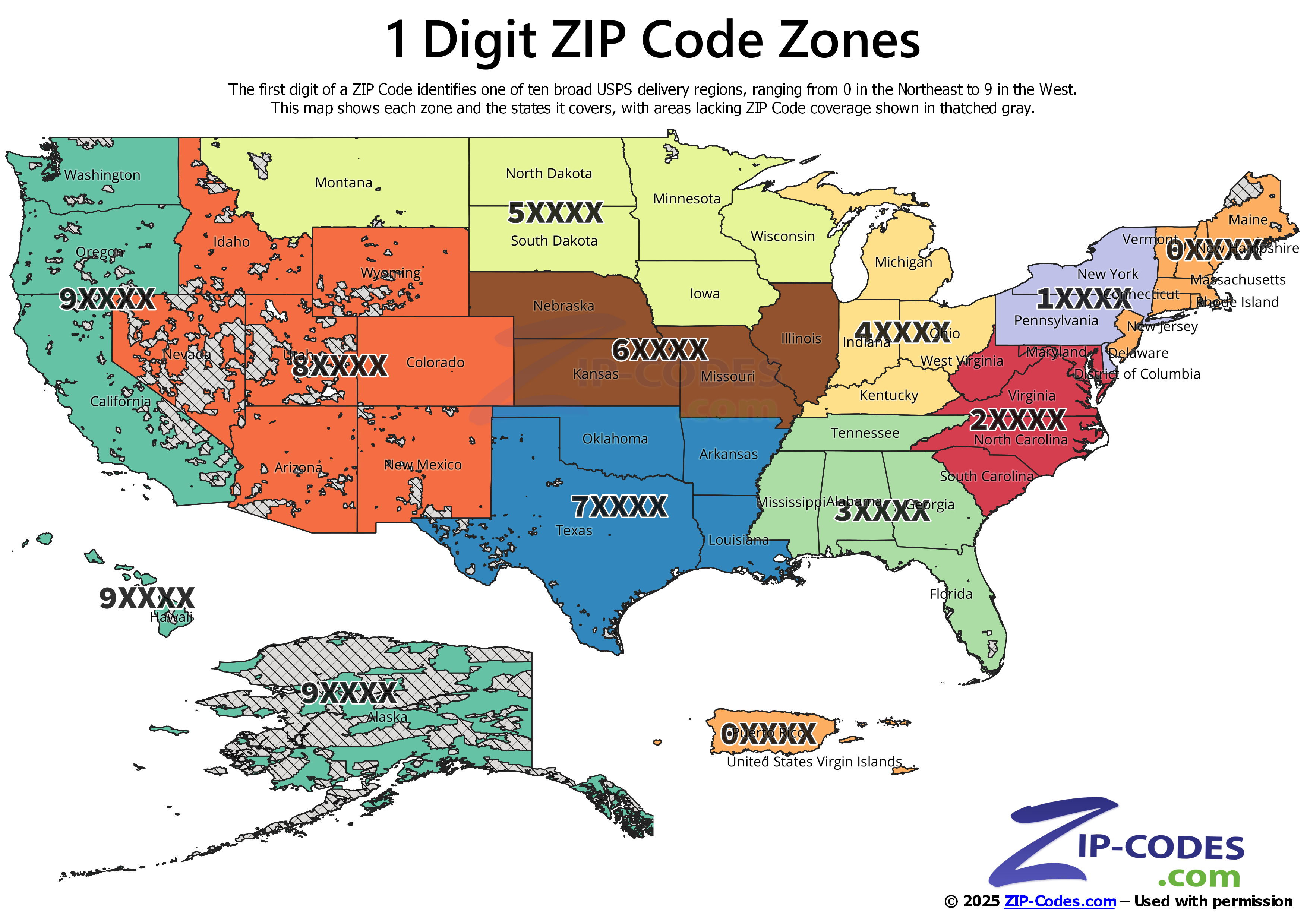
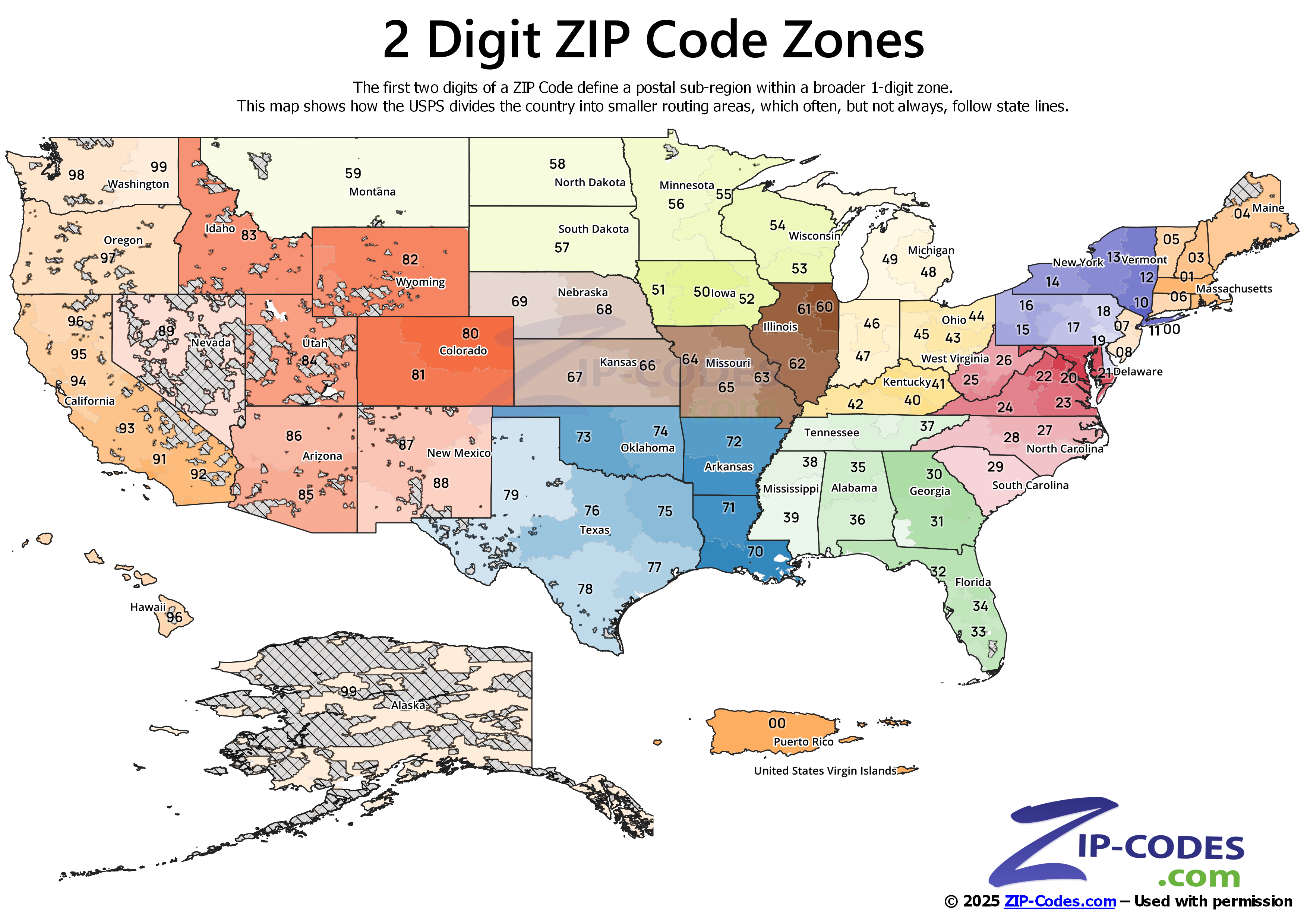
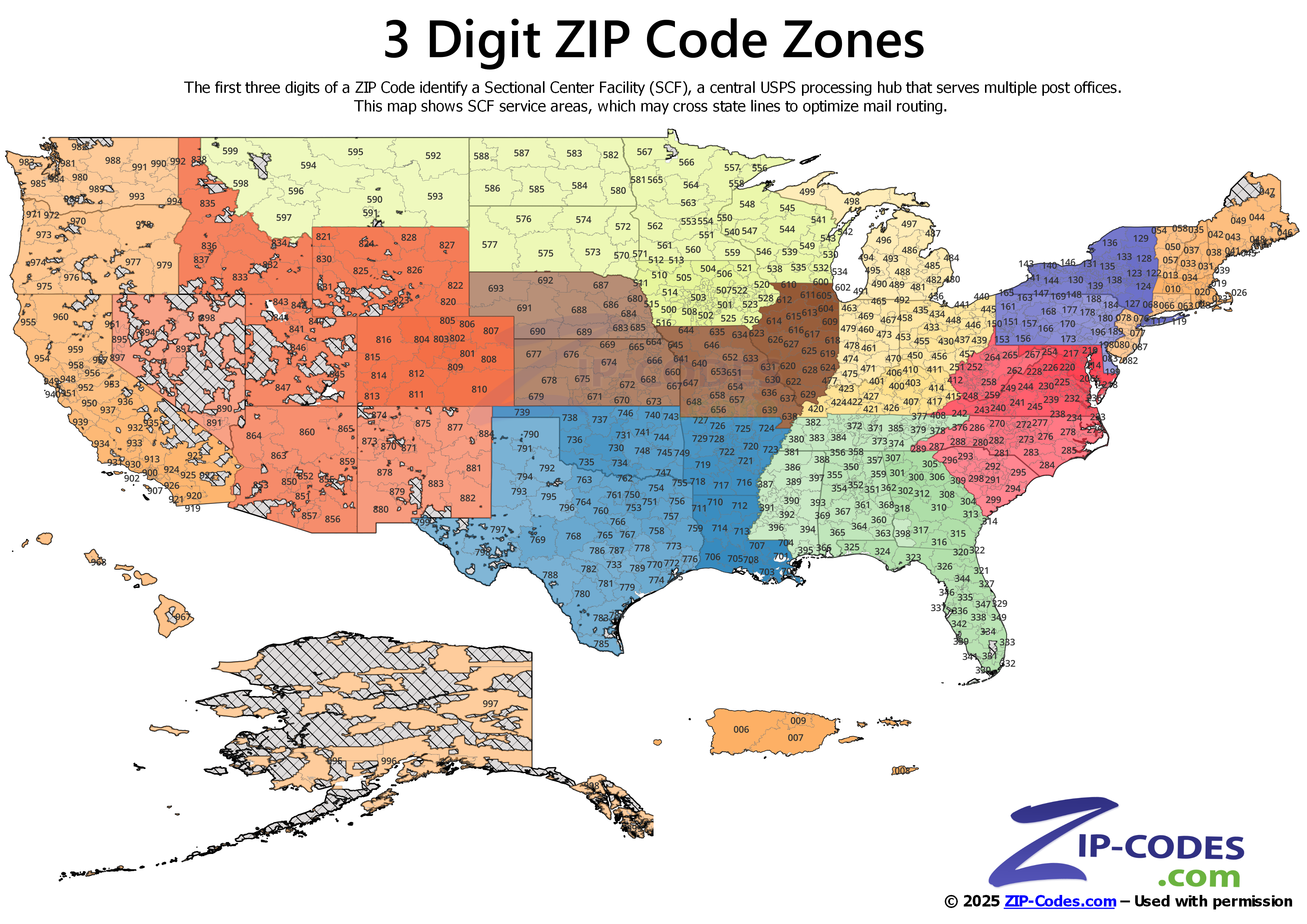
These professional zone maps were built using our ZIP Code Boundary Data. Explore how boundaries organize the U.S. postal system from national regions to detailed sectional facilities.

U.S. 1-digit ZIP Code map showing ten broad postal regions, color-coded by first digit, with state boundaries for reference.
1-Digit ZIP Code Zones

National overview showing 10 primary regions (0-9)

U.S. 2-digit ZIP Code map showing regional postal sub-regions, color-coded by first two digits, with state boundaries for reference.
2-Digit ZIP Code Zones

Regional breakdown of 100+ postal sub-regions

U.S. 3-digit ZIP Code map showing Sectional Center Facility (SCF) areas, color-coded by first three digits, with state boundaries for reference.
3-Digit ZIP Code Zones (SCF)

Detailed sectional center facilities (900+ zones)

Built with Our ZIP Code Boundary Data
41,000+ Boundaries
100% Coverage
8 Professional Formats

These maps demonstrate the quality and precision of our boundary data. Create your own visualizations with the same professional-grade datasets.

Explore Sample Boundaries


Click any ZIP Code boundary to view its complete attribute data. This interactive map demonstrates the precision and detail of our boundary dataset using a sample of the San Francisco Bay Area.

Load Interactive Boundary Map |


Explore ZIP Code boundaries for the San Francisco Bay Area. Click any boundary to see complete attribute data including demographics, county information, and geographic details.

Boundary Details

Click on any ZIP Code boundary to view detailed information including ZIP code, name, type, state, county, coordinates, and demographic data (residential count, businesses, housing units).

Showing sample ZIP Code boundaries for the San Francisco Bay Area (San Francisco, Alameda, Marin, and San Mateo counties). Download complete sample datasets with hundreds of ZIPs in all 8 formats.

Applications & Use Cases

Real-world applications for professionals across industries. From territory planning to healthcare analytics, our boundary data powers critical business decisions.

Sales Territory & Service Zone Mapping

Define precise sales territories, service areas, and operational zones using accurate ZIP Code boundaries. Visualize coverage gaps, balance workload distribution, and optimize resource allocation across your geographic regions.

KEY BENEFITS:
  • Eliminate territory disputes with clear boundaries
  • Identify underserved areas for expansion
  • Balance territories by demographic or workload metrics
  • Export territories to CRM and routing software
See Example: Zone Maps

Market Analysis & Demographic Visualization

Overlay demographic data, customer locations, and competitor presence on accurate ZIP boundaries. Identify high-value markets, analyze penetration rates, and discover growth opportunities with comprehensive market intelligence.

KEY BENEFITS:
  • Visualize customer concentration by ZIP Code
  • Compare market penetration vs. total addressable market
  • Identify demographic clusters for targeted campaigns
  • Analyze competitive coverage and market share
Try Interactive Map

Logistics Planning & Route Optimization

Optimize delivery routes, warehouse placement, and last-mile logistics using precise ZIP boundaries. Calculate service coverage areas, estimate delivery times, and identify the most efficient distribution points for your network.

KEY BENEFITS:
  • Define delivery zones with precise boundaries
  • Calculate optimal warehouse and fulfillment center locations
  • Model same-day or next-day delivery feasibility
  • Integrate with routing engines (Google Maps, Mapbox, HERE)
View Integration Examples

Healthcare Service Areas & Access Analysis

Map patient catchment areas, analyze healthcare service accessibility, and plan facility locations for equitable coverage. Identify healthcare deserts, model drive-time isochrones, and ensure communities have access to critical medical services.

KEY BENEFITS:
  • Define hospital service areas and patient catchment zones
  • Analyze healthcare accessibility by ZIP Code
  • Identify underserved populations for new facility planning
  • Model emergency response coverage and ambulance routing
View Pricing Options

Ready to put our boundary data to work for your organization?

Frequently Asked Questions

Quick answers to common questions about our ZIP Code Boundary Data. Have technical questions? See the full Technical FAQ.

Pricing varies by license tier (Single User to Unlimited) and geography (National, Single State, or Custom ZIPs up to 65). Use our pricing calculator to get instant pricing for your specific needs. National licenses start in the low thousands, while single-state and custom ZIP options offer more affordable entry points for regional applications.

Yes! We offer four free sample datasets in all eight formats:

  • 50 ZIP Diverse Sampler - Hand-picked ZIPs nationwide (urban, suburban, rural)
  • 100 ZIP Stratified Sampler - Algorithmically distributed across the U.S.
  • SF Bay Area - Multi-county regional sample (~300 ZIPs)
  • Los Angeles Metro - High-density urban sample (~400 ZIPs)

Each sample includes all 8 formats (Shapefile, GeoJSON, SQL Server, PostGIS, MySQL, KML, WKT, CSV). Visit our Technical Specs page to download samples.

Every license seat receives the same eight-format export bundle plus the year's quarterly drops — nothing is paywalled by tier within the data itself.

What ships on day one:

  • Boundary polygons in Shapefile (.shp + .shx + .dbf + .prj), GeoJSON (RFC 7946 feature collection), KML for Google Earth and ArcGIS Online overlay, WKT for raw geometry import, and three database-native flavors: SQL Server STGeomFromText scripts, PostGIS-ready WKT inserts, and MySQL spatial inserts with axis-order pragmas
  • Centroid points in the same eight formats, including ZIPs that lack polygon coverage (PO Box, Unique-recipient, Military)
  • 21 attribute columns per feature: ZIP, ZIPTYPE, primary city, state, county FIPS, MSA/CBSA codes, residential delivery count, business delivery count, total population, total housing units, area in square miles, and the RELVER vintage stamp
  • Integration cookbook with sample SQL, sample Leaflet/Mapbox load, sample ArcGIS Python toolbox snippet
  • Quarterly download notifications for the next four release cycles after purchase

Tier-specific extras: Department and Enterprise tiers include support-channel priority routing; Enterprise (50+ seats) additionally carries a named account manager and phone-channel access during business hours.

Geometries ship in EPSG:4326 (the WGS84 geographic CRS) with lon-lat axis order in every export format — Shapefile, GeoJSON, KML, WKT, and the SQL Server / PostGIS / MySQL flavors. That's the convention Leaflet, Mapbox GL, deck.gl, ArcGIS Online, and most modern map renderers expect, so polygons load without a manual reprojection.

Vertex coordinates carry 6–7 decimal places, well under polygon-edge precision. Distance and area calculations on raw lat-lon data return degrees, not meters — when accuracy matters, reproject into a UTM zone or state-plane CRS first.

Centroid files include all ZIP Codes (~33,000 records), including PO Box and Unique ZIP Codes that don't have street delivery areas. Boundary files only include polygonal ZIP Codes (~41,000 records) with geographic extent. Use boundaries for mapping and spatial analysis; use centroids for geocoding, distance calculations, and point-in-polygon queries.

Yes, some ZIP Codes serve areas in multiple states. These are represented as single polygons and assigned to the state used in their mailing address, not the state where their centroid falls. This ensures ZIP Codes align with USPS addressing conventions.

Filler ZIP Codes are synthetic ZIP Codes (###MH for water, ###MX for land) that ensure 100% continuous national coverage with no gaps or holes. They represent areas where USPS does not provide mail delivery-remote wilderness, large water bodies, national parks, military reservations.

These fillers eliminate map gaps and ensure clean topology for spatial analysis. They always have zero population and zero delivery counts. Filler ZIPs are clearly marked in the ZIPTYPE field as "FILLER" so you can filter them out if needed.

Quarterly release cadence — four shipments per license year, each one consolidating the prior three months of USPS carrier-route change-files (Pub 28 LACS, DPF, and DPV deltas) into rebuilt polygons.

Vintage stamps every record in the RELVER attribute (e.g., 202508 = the August 2025 release pulled from the August USPS publication cycle).

What rolls in between releases: net-new ZIP polygons for new construction or boundary realignment, retired ZIPs dropped, boundary edges re-walked where Census TIGER updates or USPS route restructures shifted them, and demographic counts re-aggregated against the latest population estimates.

Yes! Our data is compatible with all major GIS platforms:

  • ArcGIS: Use Shapefile format (drag-and-drop) or import GeoJSON
  • QGIS: Supports Shapefile and GeoJSON natively
  • PostGIS: Import-ready SQL scripts included with proper SRID and geometry types
  • SQL Server: Uses geography type with STGeomFromText()
  • MySQL/MariaDB: Includes axis-order specification for correct coordinate handling

Visit our Technical Specs page for detailed import instructions and code examples for each platform.

Polygon edges follow a hybrid construction pipeline: USPS delivery-route assignments seed the topology, then edges snap to Census TIGER/Line street centerlines wherever a road forms the boundary. Urban polygons typically resolve to within 50–100 meters of the true delivery line; sparser road networks (rural counties, federal land, intermountain west) widen that bound proportionally because there are fewer reference vertices to snap against.

What the precision does and does not mean:

  • Vertex storage is 6–7 decimal places, so the polygon geometry can be re-projected without losing any of the source resolution
  • Point-in-polygon containment queries at ZIP granularity ("does this address fall in 90210?") are reliable across the dataset
  • The boundaries are not parcel-level: they encode mail-delivery territory, not legal lot lines, easements, or tax-roll polygons
  • Polygon area calculations on raw EPSG:4326 geometry return degrees-squared; a state-plane or UTM reprojection is required before computing real square miles or acres

Most overlay errors people report turn out to be coordinate-order issues (lat-lon vs lon-lat) at the consumer end, not source-data accuracy issues — the dataset is consistently lon-lat across every export format.

No! Our proprietary process includes filler ZIP Codes (###MH for water, ###MX for land) to ensure 100% continuous coverage of the United States. This eliminates map gaps in areas without USPS delivery service-like remote wilderness areas, large lakes, military reservations, and national parks. Filler ZIPs are clearly marked in the ZIPTYPE field so you can filter them if needed, but they ensure clean topology and edge-to-edge coverage for professional cartography.

Four scheduled releases per calendar year, one each quarter, with bonus interim shipments only if a USPS publication carries a high enough change-rate to warrant it (rare).

Every license carries 12 months of those quarterly drops included; you get email notifications with manifest deltas as each release publishes. The last shipment in your active window stays usable forever — license expiry stops new shipments, not the data you've already pulled.

Renewal is annual and only required if you want the next quarter's polygons and centroid updates.

Two delivery channels.

Email notifications go out every release with signed download URLs and the manifest (changed-ZIP list, vintage stamp, format checksums). Your account dashboard mirrors the same downloads for as long as the license is active — pull as many times as you like, switch formats between releases, re-download a prior quarter if needed.

License expiry just freezes the available downloads list at the last in-window release; the polygons, centroids, and attribute tables you've already retrieved stay perpetually licensed under the terms in effect at purchase.

Yes — ZIP polygons are operational mail-delivery zones, so they realign whenever the USPS reorganizes carrier routes. Three flavors of change show up:

  • Edge nudges: small vertex shifts where a route handoff between two adjacent ZIPs moves a block-face from one polygon to its neighbor. Most quarterly drops contain dozens of these; individually they're under 100 m of edge movement.
  • Topology events: ZIP splits (a single growing polygon partitions in two), ZIP merges (two adjacent polygons consolidate as a route is decommissioned), and full retirements (the polygon disappears because the carrier route was dissolved). These show up roughly once per quarter nationally.
  • Attribute refresh: counts (residential, business, population, housing) re-aggregate against the latest delivery-statistics or population-estimate base, even when the polygon geometry is identical.

Each quarterly release ships the rebuilt geometry plus a changeset describing which ZIPs hit each of the three categories, so downstream pipelines can detect-and-diff rather than full-replace. Historical vintages (one year back per quarter as standard, deeper on request) are available if you need to back-test against a frozen baseline — the diff between any two quarters is recoverable from the RELVER-stamped data.

Decades of Trust: We're the ZIP Code Data Experts

Our Experts

James Harris

Lead Data Architect - 23 Years Experience

Good data doesn't just happen - it takes real people who care about getting things right. James and our team manually verify every source. No running scripts and calling it done. We maintain high standards because you're counting on this data to run your business.

When something doesn't look right, we dig into it. That's the difference experience makes.

More About Our Team →

We Stand Behind Our Work

Our 100% Money Back Guarantee!

Our mission: Provide accurate, comprehensive, and trustworthy ZIP Code data so you can make confident business decisions based on reliable intelligence.

Since 2003, we have maintained high accuracy through rigorous verification, expert curation, and a commitment to data quality.

We believe that good data matters, and so does good service. When you need help, you'll talk to an actual person - not a ticket system or an endless email thread. Call us and we'll pick up the phone. Email us, and we will respond promptly. It's a simple thing, but it makes a difference when you're on a deadline or troubleshooting an issue.

Learn Why Many Place Their Trust In Us →

Trusted by Thousands of Companies

Background image for Real Reviews from Real Customers

Real Reviews from Real Customers

Verified reviews from our Google Business profile. Read all reviews on Google

★★★★★ 4.8 out of 5 from 72 verified Google reviews
100% Verified Reviews
Verified on Google
10-20+ Year Customers

Sources & References


Our sources include trusted federal and licensed data from the United States Postal Service, U.S. Census Bureau, U.S. Geological Survey, and Centers for Medicare & Medicaid Services, along with proprietary datasets created by ZIP-Codes.com. Data last updated on June 5, 2026.

  1. U.S. Postal Service [Last Updated: 6/1/2026], https://www.usps.com
  2. ZIP-Codes.com Proprietary Data Enhancements [Updated: 6/1/2026], https://www.zip-codes.com
Portions of data are provided by the United States Postal Service and are © 2026. Zip-Codes.com is a non-exclusive licensee of the United States Postal Service.